
It’s the question I hear most in the gym: “If I lift weights, will I get bulky?” To answer it, we looked at a 2025 meta-analysis of 29 studies in which women and men followed the same strength program.
In short: On the same program, women’s muscles grew at the same rate as men’s relative to where they started. Men gained slightly more in total, and that difference showed up in the upper body. Lifting doesn’t make a woman look like a man; it makes her muscles stronger.
What did the study do?
- Study
- Refalo et al., PeerJ, 2025
- Type
- Meta-analysis: an analysis that pools the results of many studies
- Scope
- 29 studies; measurements from 1,278 men and 1,537 women
- Who
- Ages 18–45; in 23 studies participants were new to lifting
- Length
- Programs of 6–24 weeks (11 weeks on average)
In each study, women and men did the same strength program and muscle size was measured. The researchers looked at two things: how much muscle grew as a percentage of where it started (relative gain) and how much it grew in total (absolute gain).
The real difference: testosterone
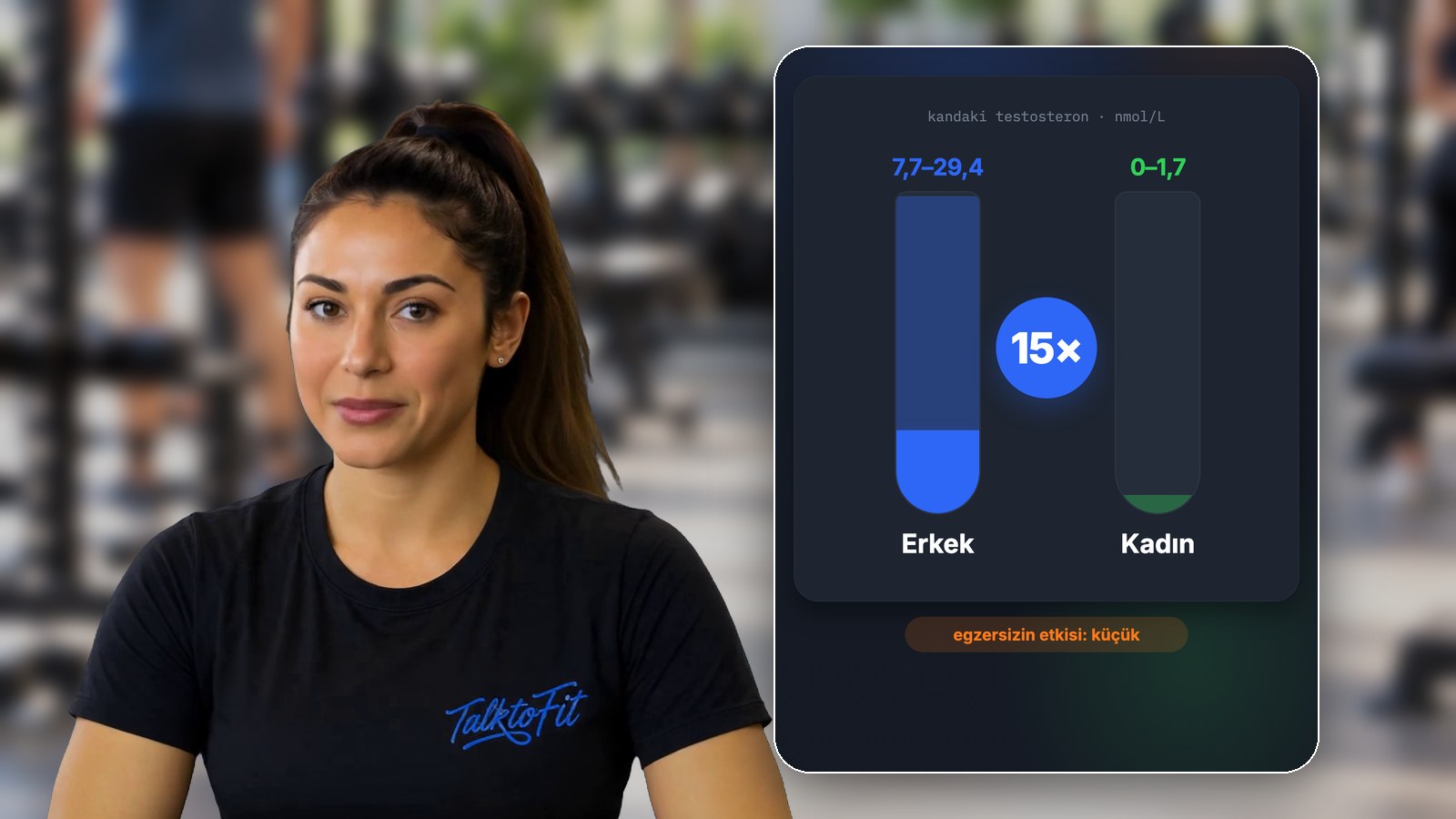
The main reason men and women differ in muscle is the hormone testosterone. According to a separate review (Handelsman et al., 2018), blood testosterone is 7.7–29.4 nmol/L in adult men and 0–1.7 nmol/L in menstruating women — more than 15 times higher in men. The same review notes that physical activity changes this gap only slightly.
What did it find?
- Relative gain was similar: the difference between men and women was only 0.69 percentage points, and the estimated range (−1.50 to +2.88) included zero. Relative to where they started, women’s muscles grew at the same rate as men’s.
- Men gained slightly more in total: men’s muscles grew a little more in absolute terms; the difference was small.
- By region: that small difference appeared in the upper body; there was no clear difference in the lower body.
Good to know
- The studies mostly involved 18–45-year-olds new to lifting, on programs of 6–24 weeks. What was measured was muscle size, not appearance.
- There is no dedicated meta-analysis of how strength training affects resting testosterone in women; the hormone figures come from the Handelsman 2018 review.
Sources
- Refalo MC, Nuckols G, Galpin AJ, et al. (2025). Sex differences in absolute and relative changes in muscle size following resistance training in healthy adults: a systematic review with Bayesian meta-analysis. PeerJ 13:e19042. doi:10.7717/peerj.19042 · PubMed · Full text (PMC)
- Handelsman DJ, Hirschberg AL, Bermon S (2018). Circulating testosterone as the hormonal basis of sex differences in athletic performance. Endocrine Reviews 39(5):803–829. doi:10.1210/er.2018-00020 · Full text (PMC)
This article is for information only and is not medical advice. Talk to your doctor about decisions that concern your health.